In this guide
A folder of PDFs is not an evidence trail unless someone can tell which file supports which statement. Municipal work often involves revised plans, amended solicitations and updated reports. A source register makes those changes visible without requiring an elaborate research system. It is particularly useful when more than one employee contributes to a briefing.
Give every source a job
Record the question a document helps answer. A title alone is not enough. “Budget book” might support a program description, while an adopted ordinance supports a different statement. A source that has no clear job may be background reading rather than evidence for the brief.
Phoenix's Budget Library separates document stages, and its procurement FAQ describes addenda in the procurement lifecycle. Those public examples show why version awareness matters. They do not prescribe a particular internal recordkeeping practice; use your department's approved systems for actual work records.
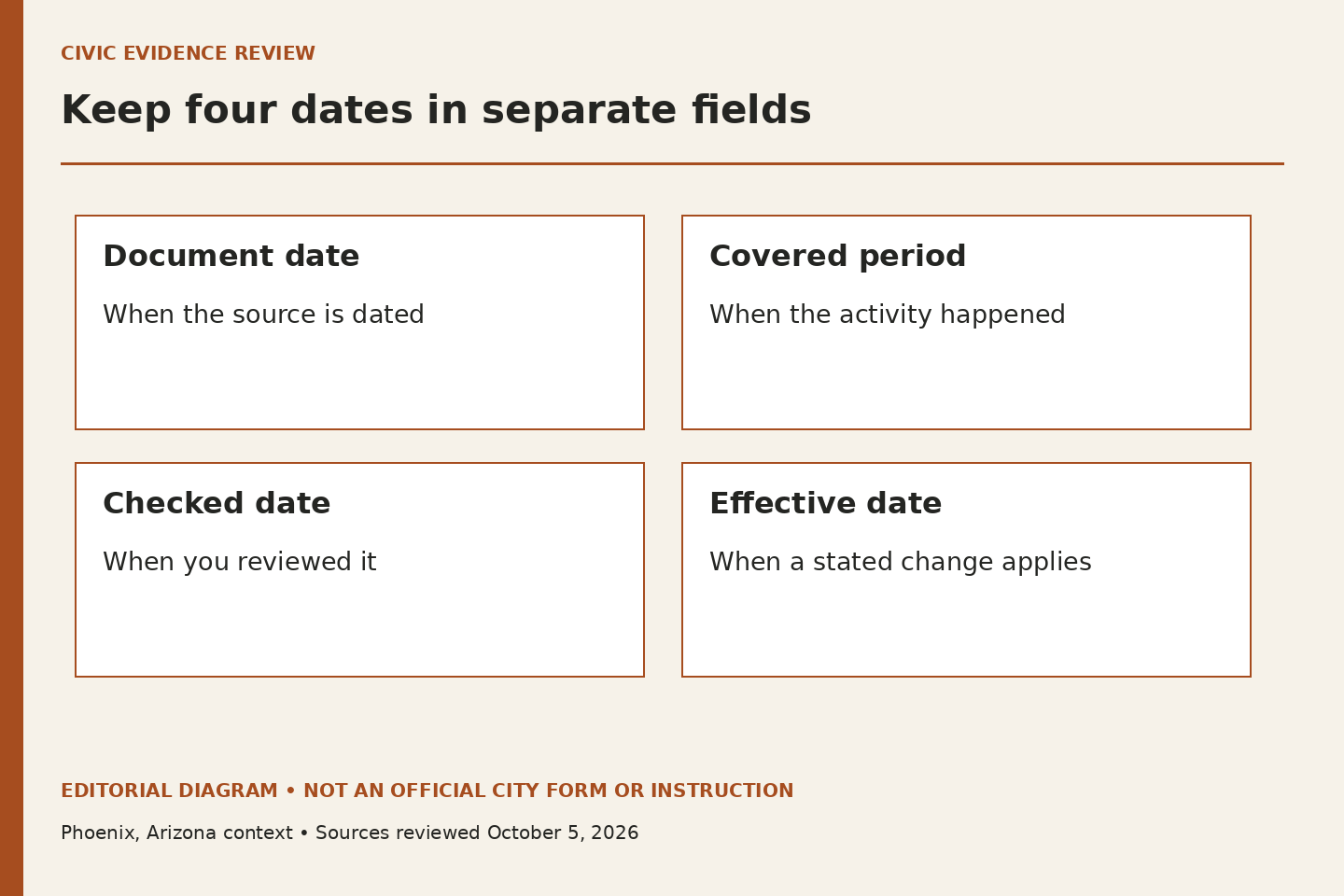
Keep four dates distinct
A useful register can separate the document's stated date, the period it covers, the date you checked it and any stated effective date. Not every source supplies all four. Leave unavailable information blank or mark it unknown rather than filling it from a file timestamp.
A downloaded filename can help you locate a copy, but it should not be the only identifier. Keep the source title, official URL and relevant page or section. If the web address later points to a revised file, those details help explain why your earlier note differed.
Mark replacement without erasing history
When a newer version appears, record what it supersedes and what changed for your question. Do not assume every revision affects every conclusion. A contact detail may change while the central table remains the same; a changed definition may require rechecking the whole comparison.
Use an invented example of a service guide whose eligibility paragraph changes. The update task is to identify which statement in your brief relied on that paragraph, revise it and mark the earlier statement as superseded. Quietly replacing the PDF while leaving the old conclusion intact defeats the purpose of the register.
Design for another reader
Keep the register short enough that colleagues will use it. Suggested fields are question, source, period, stage or version, location, checked date and supported conclusion. Add an unresolved-question field when the source does not fully answer the work question.
Do not store credentials, employee identifiers or confidential material in this publication's tool or a personal research file. A public-source register is a learning aid; official work records belong in approved locations. The useful habit is traceability, not accumulation of copies.
Sources and limits
Official public sources checked October 5, 2026. Examples and exercises are original editorial illustrations, not City records or instructions.
- Phoenix Budget Library
2026–27 budget document catalog; identifies adopted ordinances, books and stages. No numerical financial conclusion is inferred.
- New Procurement Portal FAQs
Published OpenGov procurement scope and migration context. Follow the live solicitation for deadlines and contact rules.