In this guide
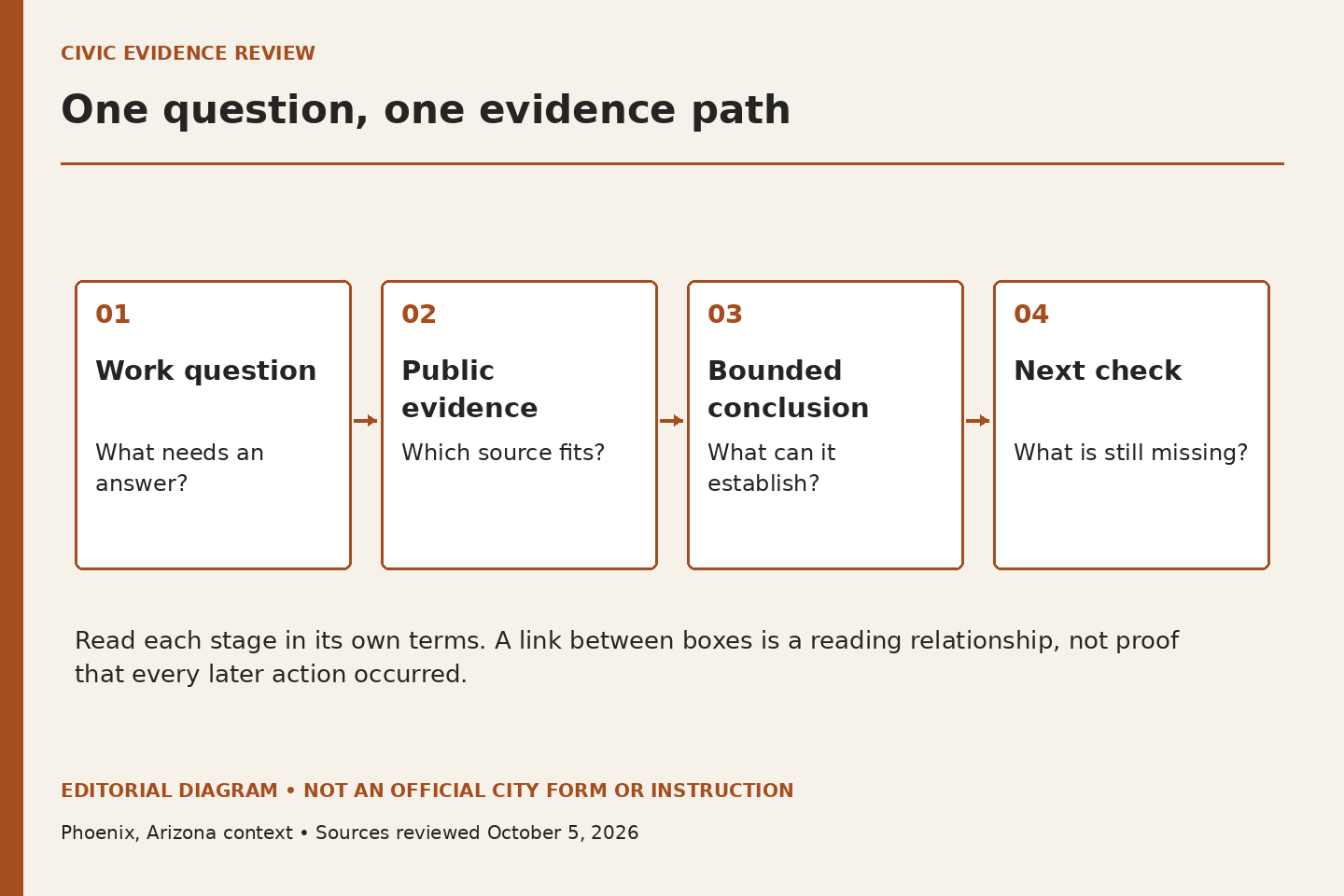
A one-page brief should help another person decide what to read or ask next. It should not merely demonstrate that its author collected many links. For a Phoenix municipal employee, a useful evidence brief connects a specific work question to a source that can answer it, then states the remaining limit. This is an editorial method for public-source practice, not the City's required memo format.
Start with the reader's decision
Write the decision or question in ordinary language. “Understand the program” is too broad. “Which published document explains the program's current budget stage?” is answerable. “Should the department change staffing?” is a consequential decision requiring much more than a public webpage. The size of the question determines whether a one-page public-source brief is enough.
Name the intended reader's role rather than inventing their preference. A budget reviewer, a service manager and a new analyst may need different context. One reader needs definitions, another needs a comparison, and another needs to know why the evidence is insufficient. A brief is successful when the reader can use it without reverse-engineering your research path.
Make the evidence reproducible
Use a source line containing the document title, publisher, date or period, page or section, and a direct link. For a changing webpage, add the checked date. Copy the definition and unit into your own concise explanation; do not rely on a screenshot that hides the heading. A person following your link should be able to locate the same evidence.
Phoenix's public data-and-evidence page provides context for performance work, while the Office of Innovation describes collaboration and pilot activity. Those institutional descriptions support a general interest in careful evidence. They do not validate your particular dataset, authorize a proposed experiment or make this publication an official training program.
Distinguish three kinds of sentence
A source fact describes what the source states. An inference explains your interpretation. A proposed next step suggests what to do about a gap. Label them in the brief, even if the final prose is smooth. Readers should never have to guess whether a number is published, calculated or hypothetical.
Consider an invented service desk example with 40 requests in one period and 50 in another. The difference is ten requests. Saying demand rose requires confidence that the periods and counting rules match. Saying another staff member is needed requires additional evidence about effort, coverage and alternatives. The same pair of numbers can support a narrow calculation without supporting the larger conclusion.
Put uncertainty where it affects the conclusion
Avoid a generic disclaimer at the bottom that tries to excuse an overconfident headline. If two periods differ, say so beside the comparison. If the document is a proposal, preserve that word in the sentence about it. If a current status is unknown, do not imply that the most recent document you found is the final word.
A useful uncertainty statement identifies the missing evidence and why it matters. “The count is unclear” is less helpful than “the table does not state whether reopened requests are counted again, so the periods cannot yet be compared as unique cases.” That gives the next reader a concrete question to resolve.
End with a decision-sized next step
The final line should name the next source or authorized review needed. It may be to consult a later report, confirm a definition, or ask the program owner about scope. It need not recommend changing a process. Sometimes the most valuable brief prevents a premature conclusion.
Use the Evidence Brief Planner on the homepage to rehearse the structure with fixed choices. It stores nothing and does not certify evidence quality. For an actual workplace brief, use approved systems and keep confidential records out of this publication. A finished brief should leave a traceable reasoning path that another reader can challenge, improve or update.
Sources and limits
Official public sources checked October 5, 2026. Examples and exercises are original editorial illustrations, not City records or instructions.
- Improving Phoenix with Data and Evidence
Published data and performance initiatives. Exercise datasets are explicitly hypothetical, not Phoenix performance claims.
- About the Phoenix Office of Innovation
Public description of collaboration, pilots and performance work. No internal training or approval workflow is claimed.