In this guide
A capital project can appear in a public plan long before a resident sees construction. For a municipal employee preparing a briefing, the task is to explain what the document says without translating a funding line into a completion promise. Phoenix publishes a multiyear capital improvement program alongside the annual budget material. Read its period and project labels as deliberately as its totals.
Begin with the physical or service outcome
Write down the asset or improvement being discussed. A building, a rehabilitation phase, a planning effort and equipment replacement are not interchangeable units. Two projects may share a neighborhood or department while delivering different things. Preserve the project identifier and the stated scope so that a later update can be matched to the same work.
A hypothetical recreation-center improvement illustrates the problem. “Center upgrade” could mean design, accessibility work, equipment or a larger construction package. If a colleague asks when the center will reopen, a funding table alone may not answer. The next question concerns the approved schedule and current project communication, not a guess based on the size of the appropriation.
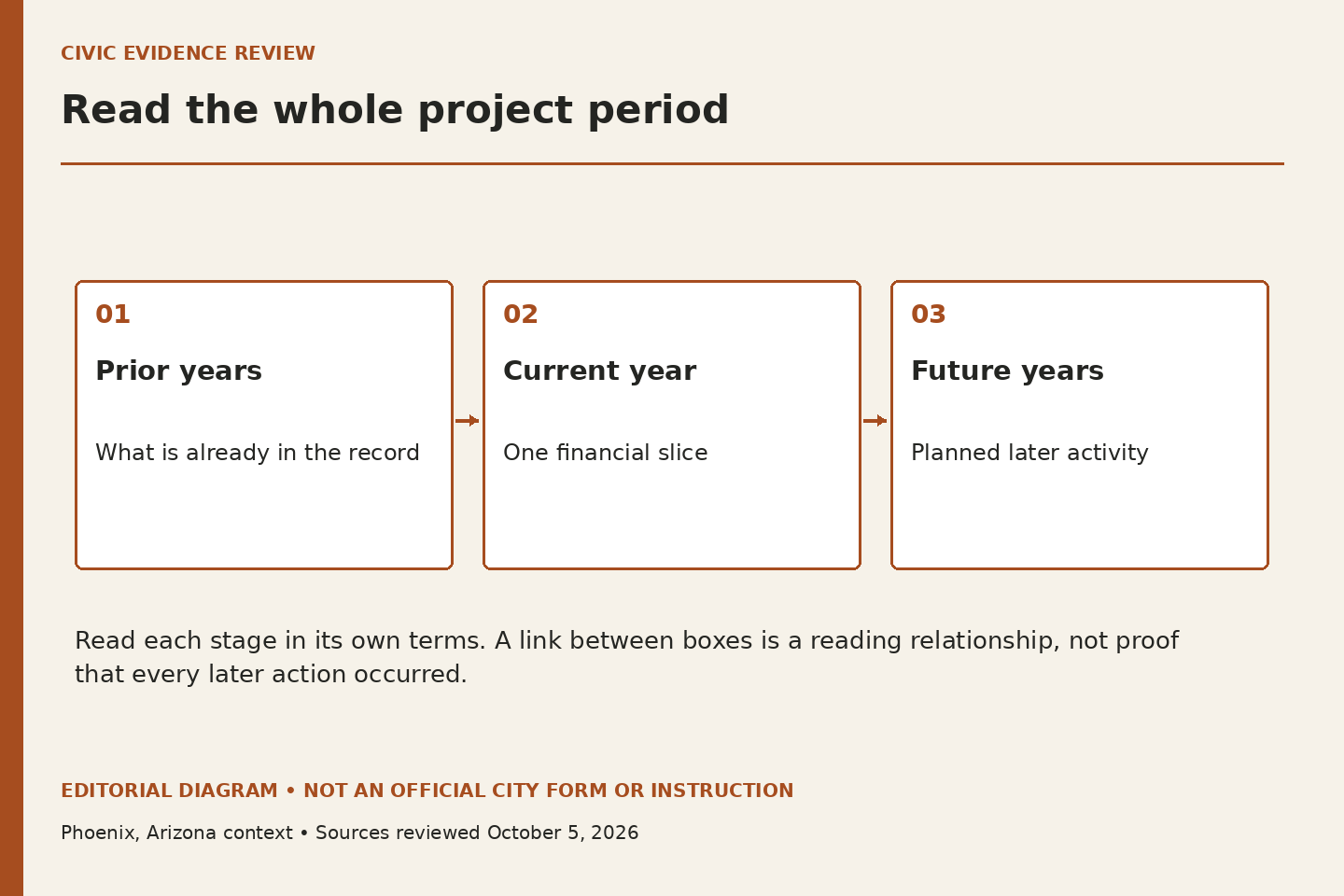
Read across years before adding amounts
A multiyear display may show prior, current and future periods. Check whether a total includes all of them and whether a separate column already incorporates an earlier amount. Adding every visible number can count the same funding twice. Note the units and any distinction between a project total and a particular year's planned expenditure.
For practice, invent a project with 20 units previously spent, 30 in the current year and 50 in later years. A 100-unit total describes the entire example, while the 30-unit figure describes one slice. Neither number tells you how much work is physically complete. The arithmetic is simple; the interpretation depends on what each column represents.
Keep funding, delivery and authority apart
A public capital plan provides context for municipal work. It does not by itself demonstrate that a contract is executed, a site is available, a design is finished or an employee may direct a contractor. Those questions require the applicable project and procurement records. A useful briefing names the missing evidence rather than presenting all later steps as automatic.
Ask which part of the project the current document covers, which dates are planned, and where approved updates are published. Avoid turning a future-year entry into a guaranteed start date. Public plans can be revised, and a revision needs to be read in its own terms rather than treated as an error in the earlier document.
Build a project reading card
Use five fields: project identity, described outcome, financial period, evidence of present stage, and the next authorized source to consult. Keep public source links with the card. If the purpose is a workplace discussion, ask the project owner to confirm any operational implication before circulating it as settled.
Finish with a sentence that preserves the distinction: the plan identifies an investment over named years; current delivery status comes from the responsible project communication. This keeps a helpful explanation from becoming an accidental promise to residents or coworkers.
Sources and limits
Official public sources checked October 5, 2026. Examples and exercises are original editorial illustrations, not City records or instructions.
- Phoenix Budget Library
2026–27 budget document catalog; identifies adopted ordinances, books and stages. No numerical financial conclusion is inferred.
- Phoenix Financial Reporting
Official directory separating annual, monthly and single-audit reporting. Accounting examples here are invented teaching examples.