In this guide
A colleague asks whether a program has money next year. Another forwards a slide from a spring budget discussion. The slide may be authentic and still answer a different question. Municipal analysts need a way to identify what a document can establish before repeating its number. In Phoenix, the useful starting point is the public Budget Library, where stages of the same fiscal year appear together.
The library checked October 5, 2026 lists the 2026–27 trial and proposed budgets, Council decision material, adopted ordinances, summary and detail books, and the 2026–31 capital program. Those are different document jobs. This review explains how to read them together; it does not certify available funds or authorize a purchase, hiring action or overtime.
Name the decision before opening a book
“Can we explain the department's adopted program?” is a reading task. “May we commit this amount today?” needs current authority and financial controls. “Did the program spend what was planned?” requires an expenditure record with an appropriate period. Write the question on the first line of your note. That small step prevents a convenient document from silently changing the question you meant to answer.
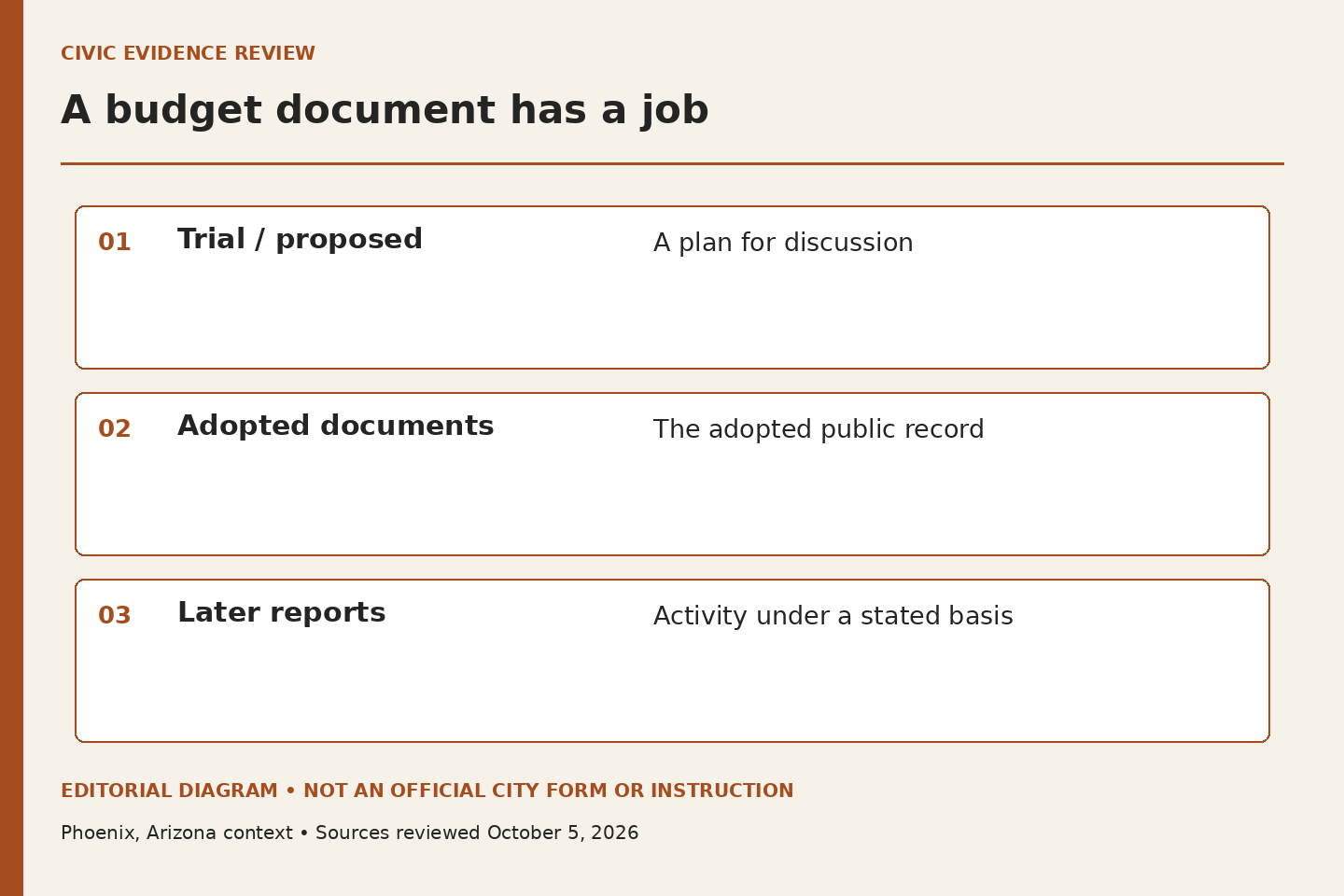
For a public-facing explanation, the summary book may provide an accessible overview. A more detailed program question can lead to the detail book. A capital project question belongs with the capital material and its funding years. Do not make the length of a document a proxy for its authority: a short adopted ordinance can perform a different legal function from a long explanatory book.
Keep stage and year attached to every number
Record the fiscal year, document title, status, page or table, and the date you accessed it. A value without those labels is difficult to check and easy to misapply. If the table contains adopted, estimated and proposed columns, copy the column heading as carefully as the value. A heading is part of the evidence, not decorative text above it.
An analyst can use a compact source line such as “FY identified on cover; adopted detail book; named department table; stated units.” Do not substitute a calendar year for the fiscal-year label. Do not call an estimate an actual merely because the period has ended by the time you read it. Later publication does not rewrite the status printed in the earlier table.
Trace a change without inventing a reason
Suppose an invented training program shows 100 units in a proposal and 80 in an adopted table. You have evidence of a difference only if the definitions and scope align. You do not yet know whether the change reflects a policy choice, a transfer, a correction, or a different presentation. Look for the accompanying decision material and notes before writing an explanation.
The public hearing page records spring 2026 events and subsequent budget stages. It is useful historical context, not an invitation to a meeting still ahead. In a briefing, say which material you reviewed and what it establishes. If the reason remains unclear, preserve that uncertainty rather than turning a plausible story into the official explanation.
Separate program context from employee records
Budget books describe public spending plans and organizational programs. They are not a substitute for an individual's employment record, leave balance or compensation decision. An employee's eCHRIS record and the public budget perform different jobs. A budgeted classification does not prove that a particular person is appointed, that recruitment is open, or that work may be reassigned.
For a workforce question, connect the budget evidence to the responsible review rather than to a named coworker. A useful query might identify the program and ask which approved staffing assumption the table represents. Keep private employee details in authorized channels. There is no reason to attach an eCHRIS screenshot to a public budget-reading exercise.
Notice what has not yet been published
As checked on October 5, the current reports page says the 2026–27 Citywide Inventory of Programs is expected in early November and links the 2025–26 inventory. That is a concrete example of why the newest fiscal year in one document does not make every linked document equally current. Label the older inventory when using it for background, and check again before relying on a later edition.
Use a small evidence register: question, document, year, stage, relevant passage, and unresolved point. The completed register should let someone else reproduce your reading without guessing which tab was open. It is often more useful than a folder containing many PDFs with no explanation of why any of them matter.
Leave the reader with a bounded conclusion
A sound conclusion might say that a named item appears in an adopted public document and describe its stated scope. It should not become a promise of a service date or confirmation of current spending authority. Ask the authorized budget or finance contact when the decision requires information beyond the published record. Good evidence reading makes that boundary visible early, while the conversation is still easy to correct.
Sources and limits
Official public sources checked October 5, 2026. Examples and exercises are original editorial illustrations, not City records or instructions.
- Phoenix Budget Library
2026–27 budget document catalog; identifies adopted ordinances, books and stages. No numerical financial conclusion is inferred.
- Current Budget Documents and Reports
Current catalog checked October 5, 2026; 2026–27 program inventory is listed as forthcoming in early November.
- Community Budget Hearings
Historical 2026 hearing and budget-development sequence; not a future meeting invitation.