In this guide
An audit report is useful precisely because it examines a defined subject through a stated method. It becomes less useful when a reader extracts a forceful sentence and drops the surrounding scope. Municipal employees may encounter audit material in planning, process improvement or a briefing. Their first job is to understand the report, not to assign blame to people who may never be named in it.
Phoenix's Audit Reports page distinguishes audits from management-service work. It says audit reports cite audit standards, while management-service communications can take less formal forms. That distinction matters when describing what kind of assurance a document offers. A consulting memo should not acquire the authority of an audit merely because both came from the same department.
Read the objective and period before the conclusion
Find the question the work set out to answer. Then note the period, locations, systems and sample described. A finding about a selected period does not automatically establish the condition on today's date. The scope can also exclude related processes that sound similar to a casual reader.
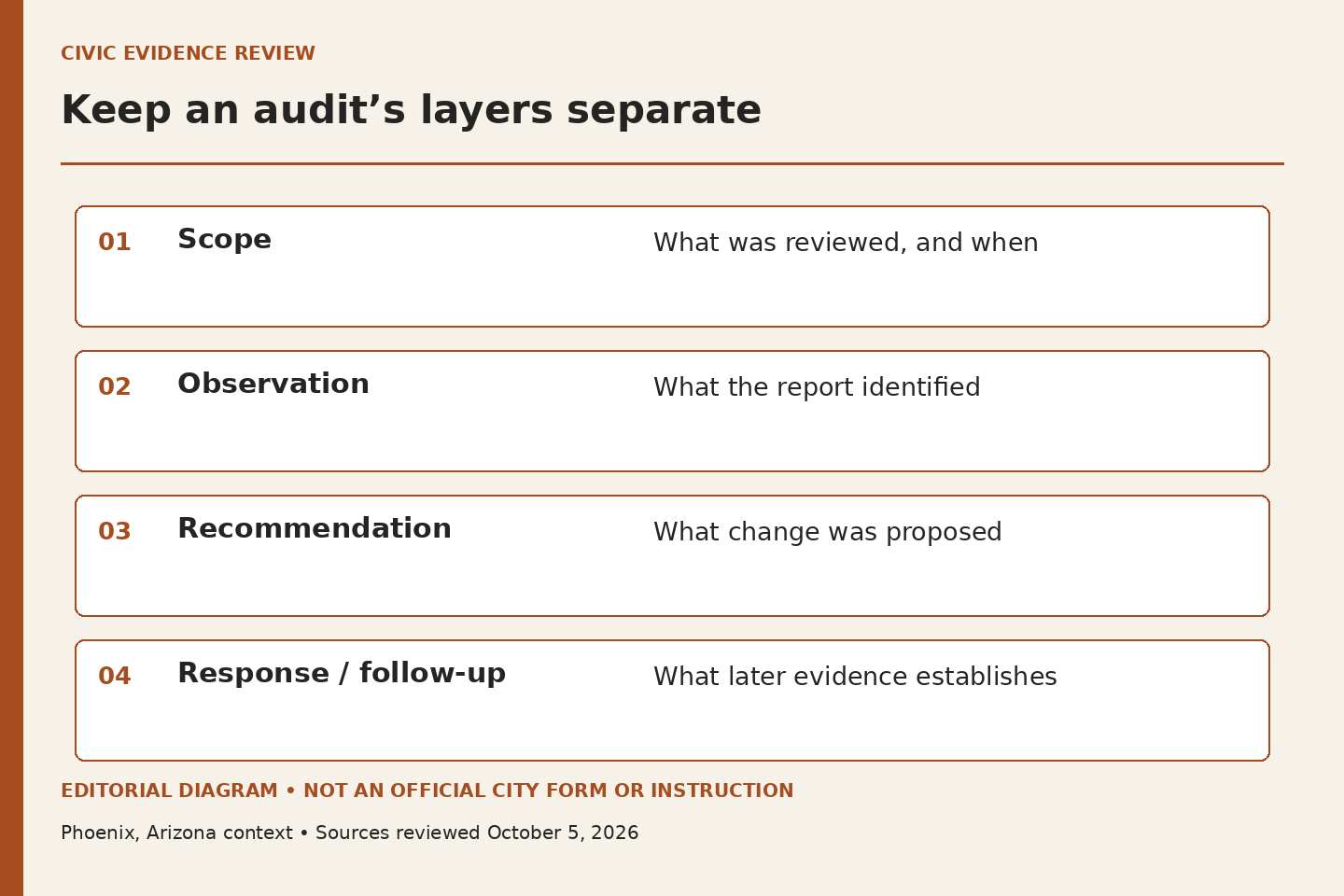
Write a one-sentence boundary statement before summarizing any finding. For example, an invented review might cover a sample of purchasing records in one quarter. That is narrower than “all purchasing.” If the report itself describes limitations, keep them visible. Removing the limits makes the summary shorter but changes its meaning.
Separate condition, consequence and recommendation
A condition describes what the review observed. A consequence explains why it matters or what risk it creates. A recommendation proposes a response. Those three pieces should not be collapsed into one allegation. A recommendation to improve a control does not, by itself, establish that money was lost or that a particular person acted improperly.
Use neutral verbs that fit the evidence: the report identified, described, recommended or recorded a response. Reserve stronger claims for findings that actually support them and for the authorized people responsible for communicating those conclusions. This article offers document-reading practice, not a legal assessment or advice about an individual complaint.
Read management's response as another part of the record
Look for agreement, disagreement, planned action, responsible function and any stated timing. A planned action is not the same as a verified completed action. Conversely, an old recommendation does not prove that no improvement has occurred. A follow-up report or current authorized update may be needed to establish present status.
In a hypothetical training discussion, a report recommends documenting a review step. Management says a new checklist will be introduced. The careful summary is that the report recommends a control and the response describes a plan. A claim that the control now works would need later evidence. A claim that staff ignored the recommendation would also need evidence.
Use the finding to frame a work question
For employees improving a process, useful questions concern the control's purpose, evidence of performance and responsibility for review. Do not copy sensitive records into a personal exercise. Use the public report or an invented example, then ask the authorized process owner how the applicable procedure works in the actual department.
The City Auditor's public description includes audits and consulting functions; the Audit Committee page describes oversight. Those pages help readers understand institutional roles. They do not grant a reader authority to conduct an investigation, demand coworker records or bypass an established reporting route.
Write a balanced briefing paragraph
A useful paragraph identifies the report and date, the scope, the relevant observation, the recommendation, and what the response or follow-up establishes. If current implementation is unknown, say so. That is a precise limitation, not a weakness to hide with confident language.
Before sharing, ask whether someone could mistake your paragraph for a current accusation against a named employee. If so, narrow it to the supported public record and seek the appropriate review. The aim is better understanding of controls and stewardship, with the dignity of people and the limits of evidence intact.
Sources and limits
Official public sources checked October 5, 2026. Examples and exercises are original editorial illustrations, not City records or instructions.
- Phoenix Audit Reports
Distinguishes audits from management-service work. A listing or historic finding is not evidence of present misconduct.
- City Auditor Department
Published audit, consulting and reporting functions; no internal access or legal finding is claimed.
- Phoenix Audit Committee
Public oversight functions; membership names are intentionally not reproduced.